Offgrid Farmstays

Off-grid land, put to work

Land that couldn't be used yesterday

Solar, storage, small wind and hydro, heat pumps, and water-from-air have moved the line on where people can comfortably stay. We help you find out whether your land is now on the right side of it — and connect you with the people who can prove it.

Free, and we'll tell you if your parcel doesn't work.

Uncover
Find the parcels with latent potential
Unite
Match landowners, operators, and trades
Create
Line up the partners who make it real
Try it now

Look up any piece of land

Drop a pin — or search an address — and see what public records say about that spot. The same sources our full screening starts from, live.

Or just click anywhere on the map. Address lookup uses the US Census geocoder; nothing you type here is stored or sent to us.

Selected location

Nothing selected yet.

Request the full screening here
County
·
USGS National Map — Governmental Units
Elevation
·
USGS Elevation Point Query Service
FEMA flood zone
·
FEMA National Flood Hazard Layer
Soil survey map unit
·
USDA SSURGO Soil Survey
Nearest mapped stream
·
USGS National Hydrography Dataset

These are raw public records for a single point — a first look, not an assessment. The full screening reads them across the whole parcel and adds what no automated lookup can: zoning and short-term-rental rules for your county, water options and nearby well records, road access, and the questions to put to licensed professionals — with an honest “this doesn't work” when that's the answer.

Public records contain errors and a point lookup can miss what a boundary survey would catch. Nothing here is engineering, legal, or financial advice — verify anything you intend to act on with a qualified professional.

How it works

Uncover, unite, create

Three connected jobs. The first two are free, because they are how the third becomes possible.

  1. 1Uncover

    Most viable land is never listed

    A great deal of acreage is priced and taxed as idle because its owner has no reason to think it could be anything else — no grid drop, no well, hard winters, rough access. Those constraints were real and they have moved. We research parcels and tell owners specifically what has changed for theirs.

    • A free screening: solar exposure, water options, access, slope, zoning posture
    • Honest disqualification — if a parcel does not work, we say so on the first call
    • For landowners, working farms, and rental property investors alike
  2. 2Unite

    Nobody holds all the pieces alone

    A landowner with acreage and no capital and an operator with capital and no land are each stuck on their own and viable together. Add the trades who want off-grid work and the suppliers who want installed volume, and the whole thing becomes possible. Connecting those parties is the point.

    • Landowners and farm owners with land to activate
    • Operators and investors with capital and hosting experience
    • Licensed builders, plumbers, and electricians looking for a pipeline
    • Guests who want places that do not exist yet
  3. 3Create

    Create the opportunity, not the building

    We are not a contractor and we do no licensed work. What gets created here is the opportunity itself — a parcel understood, an owner who knows their options, a realistic plan, and the right licensed people lined up against it. The building is done by professionals you hire directly.

    • Plain-language information on structures, power, water, and heat
    • Introductions to licensed and certified professionals
    • Introductions to operators and capital partners
    • Help thinking through permitting before it becomes the problem

Who this is for

Landowners
Raw or recreational acreage that costs you money every year and earns nothing. The goal is land that covers its own carry.
Farm owners
Income from an underused corner without changing how the farm runs — and a heat-reuse greenhouse that serves both.
Rental property investors
Off-grid inventory conventional builders cannot deliver, in a market where ordinary short-term rental supply is crowded.
Technologies

What goes into a farmstay

Five decisions, in roughly the order they matter. Our job is to help you understand them and to introduce you to the people qualified to do the work.

01

Structures

Containers, domes, tiny homes, cabins

Containers arrive as a finished shell, tolerate rough transport, and sit on simple foundations — which matters a long way from a batch plant. Domes and tiny homes suit sites where a container reads wrong. Each carries different permitting consequences, and that usually decides it.

What we'd look at
  • What does your county actually permit as a dwelling?
  • How does delivery reach the site?
  • Foundation or trailer?
Who does it

Manufacturers and licensed builders. We help you compare and make the introduction.
02

Power

Solar with storage, small wind, micro-hydro

Solar and storage is the baseline nearly everywhere. Wind can shrink the battery bank you would otherwise need, because wind and sun are strong at different times of year. Micro-hydro runs day and night where a year-round stream and useful drop exist — and brings water rights with it.

What we'd look at
  • What is the measured solar exposure, not the regional average?
  • Is there year-round flow?
  • What loads actually need to run at 3am?
Who does it

Licensed electricians and certified PV installers. Battery systems are specialised — most residential electricians have never commissioned one.

03

Water

Wells, catchment, creek intake, water-from-air

Water decides more sites than power does. A well is usually cheapest where the geology cooperates. Atmospheric water generation pulls drinking water from humidity, which can make a parcel usable when there is no well, no surface right, and no realistic path to either.

What we'd look at
  • What have neighbouring wells produced, and at what depth?
  • Do you hold a surface water right?
  • What does the county require for potable supply?
Who does it

Licensed well drillers and plumbers. Onsite wastewater is usually a separate licence again.

04

Heat

Heat pumps, greenhouses, hot water, radiant floors

Generating electricity off-grid is largely solved. Staying warm through a remote winter, comfortably, for paying guests, is what separates a site that works from one that does not. Recovered heat can extend a growing season and warm the building from the same energy.

What we'd look at
  • How cold does it actually get, and for how long?
  • Is a greenhouse worth the glazing at this latitude?
  • Where does waste heat already exist on the site?
Who does it

HVAC contractors with cold-climate heat pump commissioning experience, and plumbers for distribution.

05

Hosting

Listing, pricing, guest operations, turnover

A remote off-grid property needs more operational attention than a city rental — systems to monitor, longer turnovers, guests who need briefing. Some owners want that work; many want the income without it.

What we'd look at
  • Do you want to host, or be hosted for?
  • Who responds when a pump fails at 11pm?
  • What does your county require to permit a short-term rental?
Who does it

Property managers and experienced operators in the network. Managing rentals for others is itself regulated in some states.

What we are, and what we aren't

We are not a contractor. We don't build, install, or perform plumbing, electrical, or any other licensed work, and we don't sell it. All regulated work on your property is done by licensed professionals you hire directly.

What we do is narrower and, we think, genuinely useful: work out whether your land can support a farmstay at all, explain the technologies in plain terms so you can judge the advice you get, and introduce you to people who have done this before. The screening and the introductions are free.

The Systems That Move the Line

Power, water, and heat. Which combination a site needs depends on the site — that is what the screening is for.

Power

Solar & Battery Storage

The baseline on nearly every site. Panels sized against real measured exposure rather than a regional average, with storage sized for the nights and cloudy stretches the site actually gets.

Small-Scale Wind

Useful where solar alone leaves a winter gap. Wind and sun tend to be strong at different times of year, so a modest turbine can shrink the battery bank you would otherwise need.

Micro-Hydro

Where a year-round stream and useful elevation drop exist, hydro runs day and night in all weather. It requires flow measurement across seasons and careful attention to water rights.

Water

Atmospheric Water Generation

Extracts drinking water from humidity in the air. On a parcel with no well, no surface water right, and no realistic path to either, this is often the system that decides whether the site is usable at all.

Wells & Catchment

Drilled wells, rainwater catchment with filtration, or creek intake where rights allow. Usually the cheaper option when the site supports one — we check these first.

Climate & Heat

Air-Source Heat Pumps

Primary heating and cooling, moving heat rather than generating it. Cold-climate units hold useful output well below freezing, and ground-source loops remain an option where excavation is already happening.

Heat-Reuse Greenhouses

Low-grade heat that would otherwise be vented goes into a greenhouse instead, extending the growing season. One energy input, two outputs: something for guests to walk through and something the property actually produces.

Heat Reuse Into the Building

Captured heat routed to domestic hot water, radiant floors, and hot tubs. Recovering heat you have already paid to produce is usually cheaper than producing more.

Bitcoin Mining as a Heat Source

A small miner is an electrical load that produces heat and earns something while doing it. On some sites that makes it a reasonable way to solve two problems at once — but it is one option inside the heating and load-balancing conversation, not a reason to build anything.

  • ·Space heating for the structure
  • ·Hot water and hot tub heating
  • ·Energy balancing — an interruptible load that absorbs solar overproduction instead of curtailing it, and sheds when the building needs the power

Plenty of the properties we work on will never have a miner on site. That is a completely normal outcome.

Heat Is the Hard Part

Generating electricity off-grid is largely a solved problem. Staying warm through a remote winter — comfortably, for paying guests — is what separates a site that works from one that doesn't.

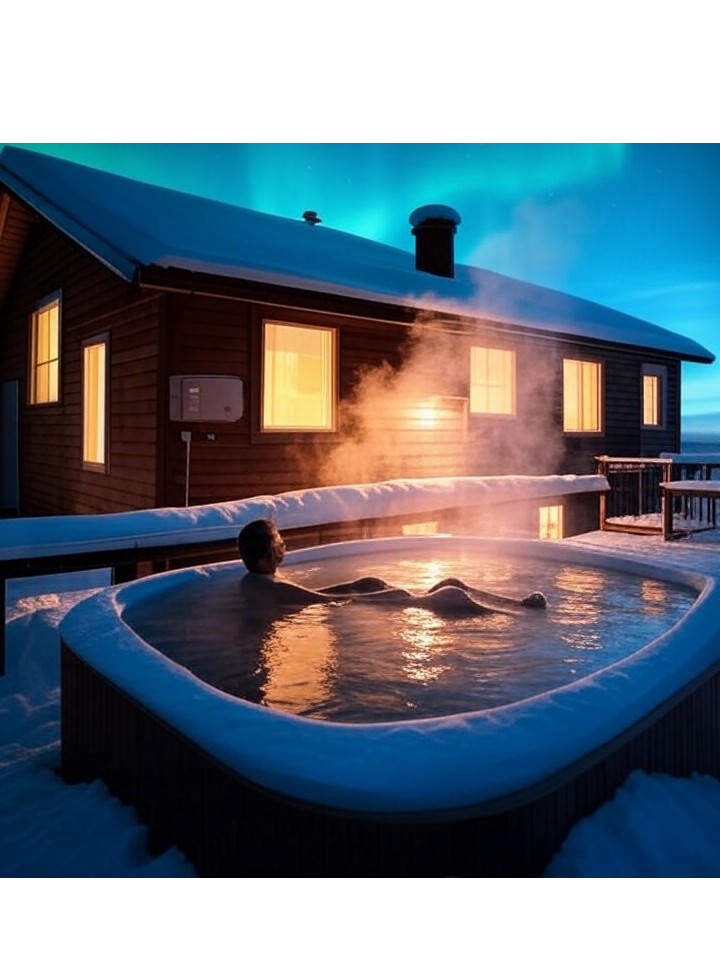
An outdoor hot tub steaming on a snow-covered deck beside a lit cabin at night

Heat-Reuse Greenhouse

Recovered low-grade heat extends the growing season well past what the climate allows on its own. Guests get something to walk through in the cold months; the property gets an actual output.

Spa & Hot Tub Heating

An outdoor hot tub that holds temperature through a hard freeze is the amenity guests remember, and heating water is one of the most expensive things an off-grid property does.

Hot Water & Radiant Floors

Domestic hot water and radiant floor loops are the largest steady heat demands in the building — and the easiest to serve with heat that has already been paid for.

Where the heat comes from

Heat pumps

The primary source on most sites — moving existing heat rather than making it

Solar thermal

Direct water heating on sites with the exposure to support it

Recovered waste heat

Heat already being produced and vented, captured and put to work instead

Small-scale mining

Optional — a load that pays for its own electricity while it warms things

Off-Grid Infrastructure, Explained

What each system actually involves, so you can read a quote and know what you're looking at. All of this work is done by licensed specialists.

Water Systems

Well Drilling

Professional geological survey and water table assessment. Drilled wells with submersible pumps and pressure systems. Water quality testing and treatment planning.

Rainwater Harvesting

Roof catchment systems with first-flush diverters. Storage tanks with filtration and UV purification. Integration with household plumbing and irrigation.

Creek & River Access

Water rights assessment and permitting. Intake systems with screening and filtration. Seasonal flow considerations and backup systems.

Atmospheric Water Generation

Drinking water extracted from humidity in the air. The fallback that makes a parcel usable when there is no well, no surface water right, and no realistic path to either.

Septic & Wastewater

Septic System Design

Percolation testing and soil analysis. Properly sized septic tanks and drain fields. Compliance with county health department regulations.

Alternative Systems

Aerobic treatment units for challenging soils. Mound systems for high water tables. Composting toilets and greywater systems where appropriate.

Maintenance Planning

Access points for pumping and inspection. Regular monitoring schedules. Guest education materials for proper system use.

Hydroelectric Power

Site Assessment

Flow rate measurements across all seasons. Head pressure calculations and elevation surveys. Environmental impact and fish passage considerations.

Micro-Hydro Systems

Turbine sizing and intake design. Penstock routing and powerhouse placement. Grid-tie or battery storage integration with solar.

Permitting & Rights

Water rights verification and documentation. Federal, state, and local permits. Environmental compliance and monitoring requirements.

Site Preparation

Access & Roads

Grading and road construction for equipment access. Utility trenching for buried lines. Erosion control and drainage management.

Foundation Work

Soil testing and bearing capacity analysis. Frost depth considerations for footings. Excavation for basements or crawl spaces.

Sequencing

Well drilling generally precedes foundation work, septic fields have to sit clear of water sources, and utility routing is cheapest when it is planned before anything is dug. Sequence errors here are expensive to undo.

Why the order matters

These systems constrain each other, and getting the sequence wrong is one of the more expensive mistakes on an off-grid site. Worth understanding before you start hiring.

Water comes first

Whether a well produces, and where, decides where everything else can sit. It is also the answer most likely to end a project.

Then the constraints

Septic placement has to stay clear of water sources, and both have to work with the terrain — so the building location is often decided for you.

Permitting throughout

Your design professionals and contractors carry the applications. The county planning department is the authority, and calling them early is free.

Process

From parcel to booking

The full path, when a project runs end to end. We're involved in the first two phases; licensed professionals you hire carry the rest.

  1. 01

    Screening & Discovery

    Week 1–2Us

    Free first pass on the parcel: solar exposure, water options, road access, slope, zoning posture. If it does not work, this is where we tell you.

  2. 02

    Options & Introductions

    Week 3–6Us

    What the realistic choices are for structure, power, water, and heat on your specific site — and introductions to the licensed professionals and suppliers who can quote and design them.

  3. 03

    Permitting

    Week 7–18Your professionals

    Your design professionals and contractors take this on: building permits, septic and well approvals, water rights, short-term rental zoning. The least predictable phase and the one that kills projects — we help you know what to expect and who has done it in your county.

  4. 04

    Construction

    Week 19–34Your professionals

    Performed entirely by the licensed contractors you hire. Site work and access, water and waste, foundation, structure, plumbing and electrical, energy systems. We stay useful as a second set of eyes, not as a trade.

  5. 05

    Launch

    Week 35–38Your professionals

    Commissioning and water testing by your installers. Then listing setup, pricing, and photography — run by you, or by a management partner from the network.

Week ranges describe a project without complications. Permitting is the phase that moves, and it moves by county — a jurisdiction that has never approved an off-grid short-term rental can add months on its own. We would rather set this expectation now than during phase three. Plenty of owners come to us for just one conversation, or one introduction.

Find Out What Your Land Can Do

A free site screening, and an honest answer — including “this parcel doesn't work,” if that's the answer. No cost, no obligation.

Which describes you best? *
Preferred Contact Method *
What would you like to understand better?

Tick anything you're curious about. This isn't an order — it tells us what to cover and who might be worth introducing you to.

We use these details to prepare your screening and to contact you the way you asked. If it would help to introduce you to someone else in the network — an operator, an investor, or a supplier — we ask you first. We don't sell your information. Ask us to delete it at any time and we will.